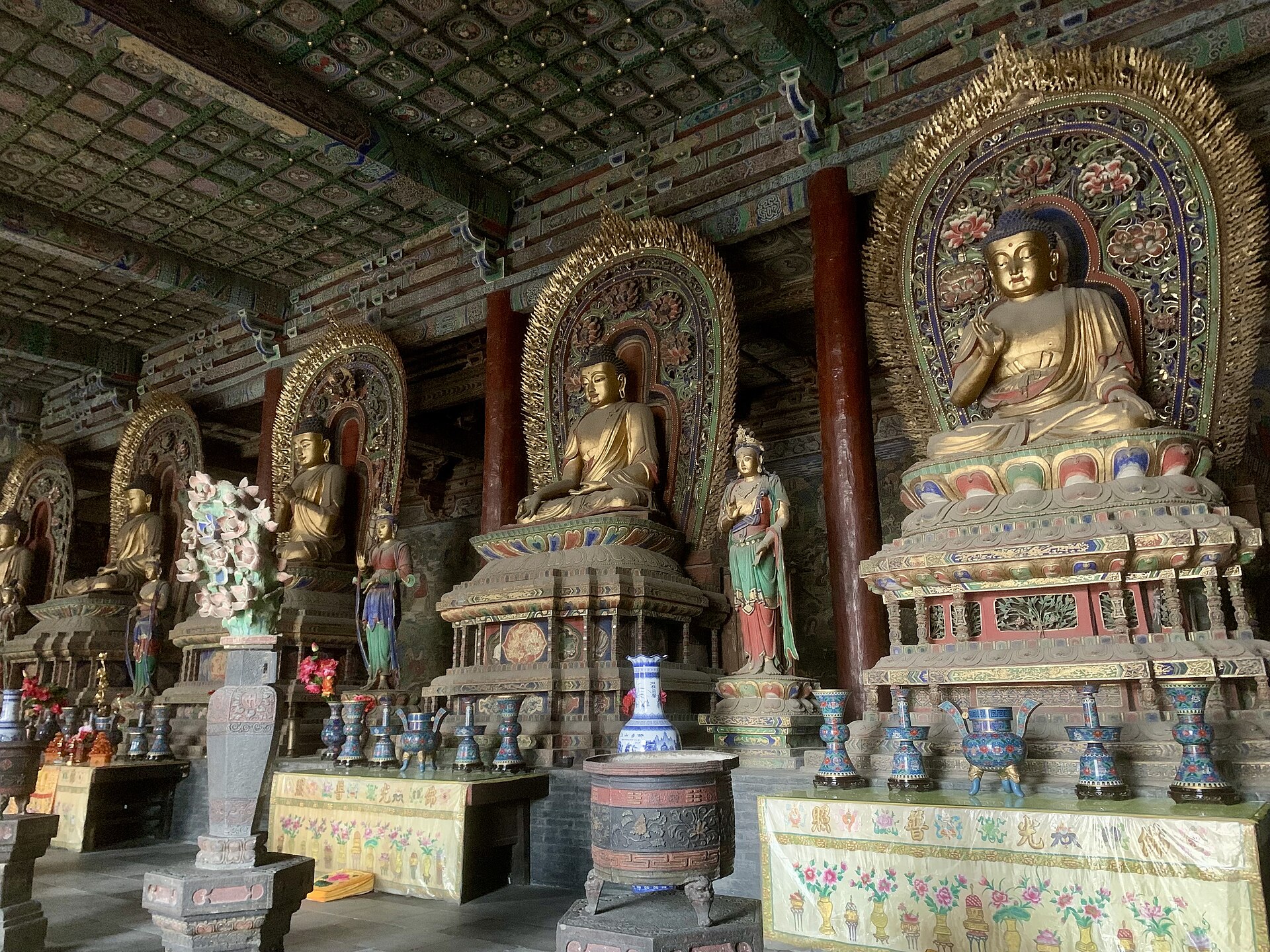
Huayan Temple: a local guide
Huayan Temple is the finest Liao-dynasty temple in China, standing in the middle of Datong Ancient City. It was the royal ancestral temple of the Liao emperors, and two of its halls hold treasures that survived a thousand years of war and rebuilding. Come for two halls and one face — the great hall, the sutra repository, and the bodhisattva who smiles with her teeth showing.
The two halls to see
- The Mahavira Hall — built on a Liao foundation and rebuilt under the Jin dynasty, nine bays wide, one of the largest Liao–Jin Buddha halls still standing in China. It is a heavy, solemn building, and its size is the point: the Liao emperors built it to match their idea of themselves. The roof ridge carries great glazed ridge ornaments, and in the rainy season swifts circle the ridge like a living painting.
- The Bhagavat Sutra Repository Hall — the treasure of the temple. A Liao hall from the 11th century, still standing on its original structure, with wall cabinets running around three sides of the interior. The great architectural historian Liang Sicheng called it a unique treasure in all China. Look for the attendant bodhisattva with her palms pressed together and her teeth showing in a smile — the most human face in Chinese Buddhist sculpture, and the one detail every visitor remembers.
Why it faces east
Nearly every temple in China faces south. Huayan Temple faces east — it sits in the west and looks toward the sunrise. The reason is the people who built it: the Khitan rulers of the Liao dynasty worshipped the sun, and they set their royal temple so that the Buddha would greet the morning light. It is the only temple of its kind in northern Shanxi, and it is the reason to come in the morning: in the afternoon you are looking into the light, and the great hall turns its back on you. Go first thing, when the sun is on the hall fronts and the temple is quiet.
The rest of the temple
Huayan Temple is larger than the two treasure halls. The entrance halls and courtyards include buildings from later centuries, and some are recent reconstructions — fine to walk through, but the history is in the two halls. In the courtyard stands an octagonal stone sutra pillar, its lower half Liao and its upper half Jin, carved with scripture. Photography is allowed in most of the temple without flash or tripod, and the great hall and the bodhisattva can be photographed freely; a few protected exhibition areas ask you not to, and the signs make that clear.
Pair it with Shanhua Temple
A short walk from Huayan Temple stands the old city's other Liao–Jin original: Shanhua Temple. Its Three Saints Hall is a Jin hall roofed on just four great pillars, with slanted arches that open like a lotus, and its great hall holds Jin painted sculptures. In the temple is a Song-dynasty stele left by an envoy who was held in Datong for fourteen years before he was allowed home — the oldest written record of the temple. The two temples together are a half day, and they are the reason to come to Datong's old city at all. From Shanhua Temple it is a short walk to the Nine-Dragon Screen, across the street from Prince Dai's Mansion.
Frequently asked questions
How long do I need at Huayan Temple?
About two hours, unhurried. That covers the two treasure halls, the sutra pillar and a slow look at the painted sculptures. Pair it with Shanhua Temple, a short walk away, for a half day of Liao and Jin art in the old city.
Why does Huayan Temple face east?
It was built under the Liao dynasty, whose Khitan rulers worshipped the sun. The temple sits in the west and faces east, so the Buddha greets the morning sun — the opposite of the usual Chinese temple, which faces south. It is the only temple of its kind in northern Shanxi.
What is the palms-pressed, teeth-bared bodhisattva?
A Liao-dynasty attendant bodhisattva in the Bhagavat Sutra Repository Hall, famous for its expression: palms pressed together in prayer, mouth open in a slight smile that shows the teeth. It is one of the most photographed sculptures in Shanxi, and one of the most human — it looks less like a god than like a person caught mid-prayer.
Can I take photographs inside Huayan Temple?
In most of the temple, yes — without flash and without a tripod. A few protected exhibition areas ask you not to photograph, and the signs make that clear. The great hall and the bodhisattva can be photographed freely.
Plan your private trip
Tell us your dates and party size — we reply within 24 hours with a draft route and a clear quotation. Every tour is private, with an English-speaking guide and a private driver.
Huayan Temple is a stop on our 4-day Datong & Pingyao tour (from US$999 per person), our 5-day Datong, Mount Wutai & Pingyao tour (from US$1,026 per person) and our 6-day Seoul route (from US$1,299 per person). See it with Datong Ancient City and the Yungang Grottoes. To plan a private Datong visit, email us at 18635571515@163.com or message us through the Jinji Yousheng (晋迹有声) WeChat mini program.