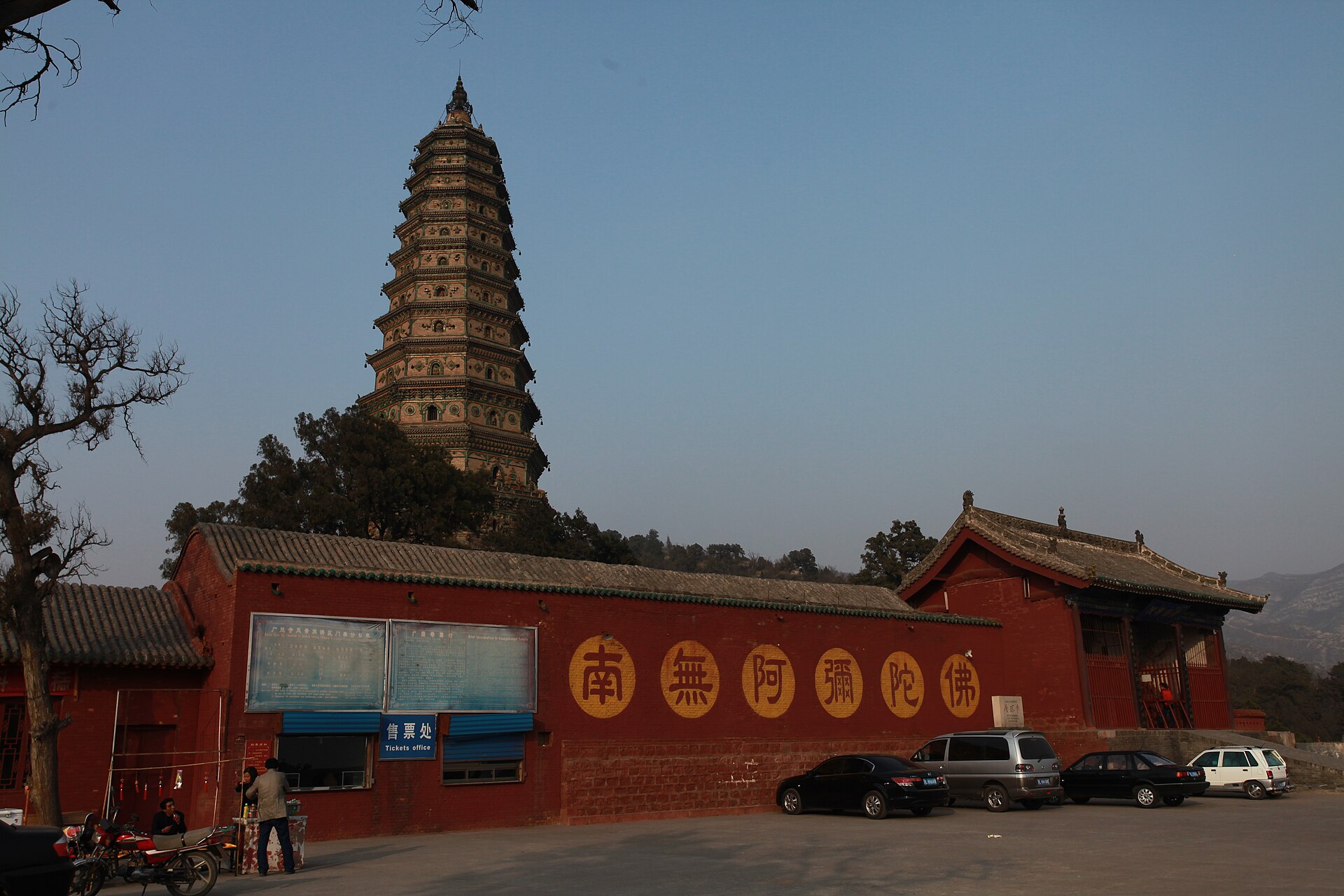
Guangsheng Temple: a local guide
Guangsheng Temple in Hongdong holds three treasures: a glazed pagoda that shines like a rainbow, a Jin-dynasty Buddhist canon with a wartime rescue story, and Yuan-dynasty murals that show ordinary people instead of gods. It is one of the great temples of southern Shanxi, and it is still quiet enough to enjoy slowly. Plan half a day, walking from the bottom to the top.
The Feihong Pagoda
The pagoda is the visual centre of the whole temple: an octagonal tower of thirteen storeys, more than forty metres high, its brick body covered from the second storey up in glazed tiles of yellow, green, blue and white. Buddhas, bodhisattvas, flying apsaras, coiled dragons and lions crowd every face, layer after layer, each storey different from the last. In sunshine the tiles throw back the light and the tower seems to shine like a rainbow — that is where the name comes from. It was the filming location for the "Sweeping the Pagoda" episode of the 1986 television Journey to the West, and in the 1930s Liang Sicheng and Lin Huiyin praised the quality of its glaze and modelling. The pagoda is viewed from the ground, walking around it — that is the right way to see it, because the glazed figures are meant to be looked at from below. Come on a sunny day, when the colours are at their fullest.
The Zhaocheng Canon
In the Amitabha Hall behind the pagoda stands a row of dark-red sutra cabinets. The great Jin-dynasty printed Buddhist canon known as the Zhaocheng Canon was once kept in them. The canon lay forgotten for centuries until it was rediscovered in 1933, and during the war against Japan it was carried away in the night by local people to keep it from falling into enemy hands. It is now in the National Library in Beijing, counted among its greatest treasures, and the cabinets still stand in the hall — a reminder that the temple's history is not only about buildings, but about the people who saved them.
The Water God Temple murals
At the foot of the mountain, beside the Huo Spring, stands the Water God Temple, and its walls hold the third treasure: Yuan-dynasty murals that are unlike any others in China. They are not about Buddhas or Daoist gods, but about water — praying for rain, receiving rain, giving thanks — and about the everyday life of the Yuan dynasty: people playing ball games, drinking, selling fish, going to the theatre. One mural on the south wall shows a full opera troupe on stage, actors and musicians together, and it is the only large Yuan theatre mural ever found — it is printed in Chinese history textbooks. The hall is dim and flash photography is forbidden, so look slowly, with your eyes. It is the most rewarding room in the temple, and the easiest to rush past.
How to walk it
The temple is built in three parts — the Upper Temple on the mountaintop, the Lower Temple at its foot, and the Water God Temple beside the spring — and the right way to see it is from the bottom up: the Water God Temple and the Lower Temple first, then the climb to the Upper Temple and the pagoda. The Lower Temple's great hall is a Yuan timber building, and its great murals were stripped and sold overseas in the late 1920s — what survives in place is a small fragment, high on the gable, and it is worth looking up for. The temple's buildings are mainly Yuan and Ming, rebuilt many times over a history that reaches back to the Eastern Han dynasty, and the whole place rewards a guide who can tell the buildings apart.
Frequently asked questions
What are the three treasures of Guangsheng Temple?
The Feihong Pagoda, the Zhaocheng Canon and the Yuan murals of the Water God Temple. The pagoda is a glazed tower that shines like a rainbow in the sun; the canon is a Jin-dynasty printed Buddhist canon, rediscovered in 1933; and the murals are the only ancient Chinese murals that show everyday life instead of gods.
Can you climb the Feihong Pagoda?
No — the pagoda is viewed from the ground, walking around it. That is the right way to see it: the glazed figures on its thirteen storeys are meant to be looked at from below, and the tower is at its best in sunshine, when the tiles catch the light.
Where are the Yuan murals?
In the Water God Temple, at the foot of the mountain beside the Huo Spring. The murals cover the walls of the hall and show water worship and everyday Yuan-dynasty life — including a famous opera scene, the only large Yuan theatre mural ever found. No flash photography; the hall is dim, so look slowly.
How does Guangsheng Temple fit with Hukou Waterfall?
They are the two great sights of the south, both in the Linfen area, and they pair naturally: the temple in the morning, the Yellow River in the afternoon. Both sit on the southern leg of our 7-day Shanxi Panorama.
Plan your private trip
Tell us your dates and party size — we reply within 24 hours with a draft route and a clear quotation. Every tour is private, with an English-speaking guide and a private driver.
Guangsheng Temple is a stop on our 7-day Shanxi Panorama (from US$1,599 per person). See it with Hukou Waterfall and Xiaoxitian. To plan a private southern Shanxi visit, email us at 18635571515@163.com or message us through the Jinji Yousheng (晋迹有声) WeChat mini program.