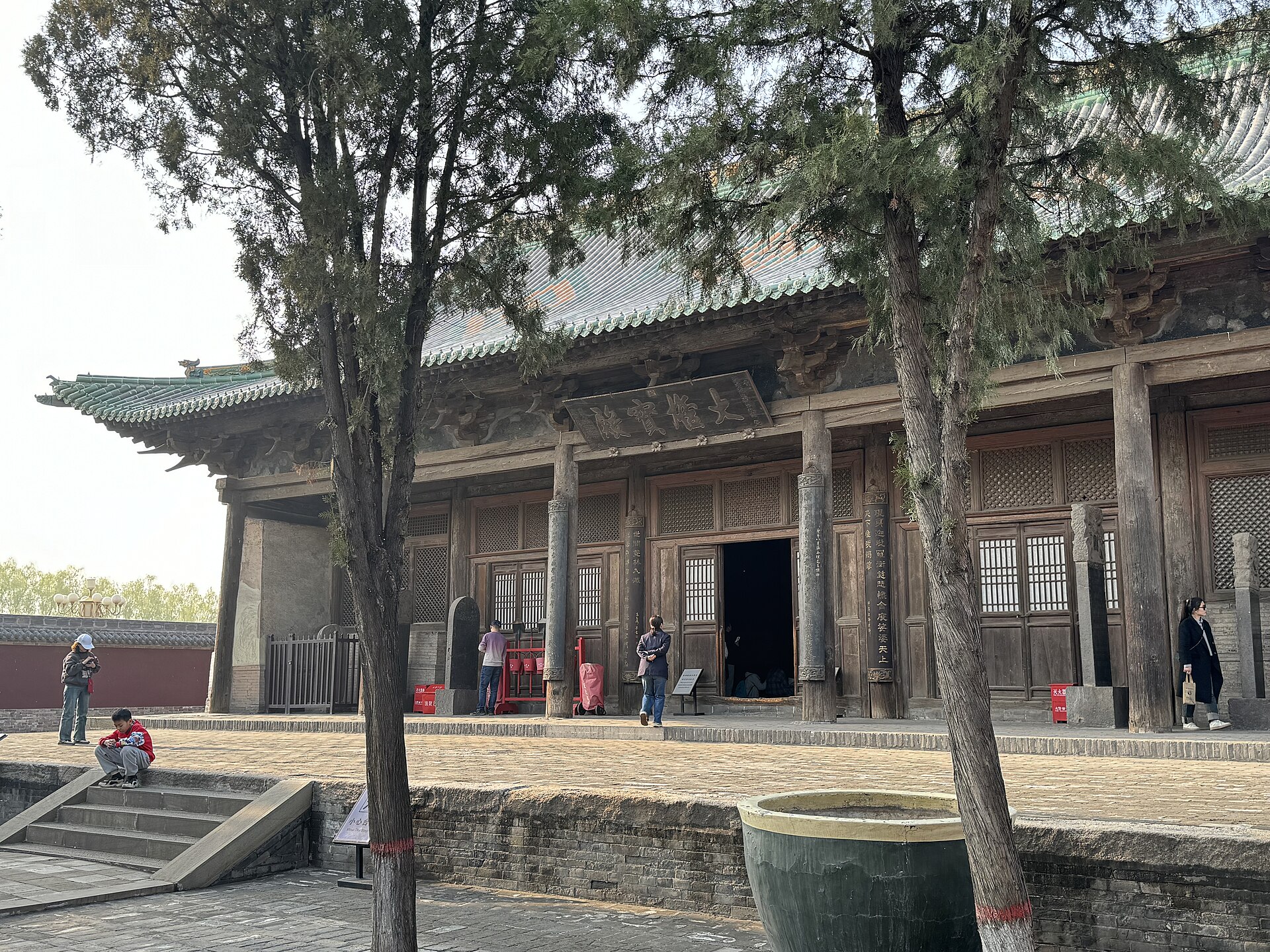
Shuanglin Temple: a local guide
Six kilometres outside Pingyao's walls, Shuanglin Temple holds more than 2,000 painted clay sculptures — for many art historians, the single finest collection of Chinese polychrome sculpture anywhere. Most day-trippers never come here, which is exactly why you should: the temple is quiet, the halls are full, and the figures have been waiting a thousand years for someone to look at them properly. Plan a morning here, with a guide.
The sculptures
The sculptures span the Yuan, Ming and Qing dynasties, and they fill the halls from floor to ceiling — bodhisattvas and arhats, guardians and heavenly kings, and ordinary people too, each one different in age, dress and expression. The ancient sculptors did not make them to a formula: a wrist turned one way, an eye set with dark glass, and the clay comes alive. Look for the Thousand-Armed Guanyin, the self-existent Guanyin, and the guardian Weituo — the figures visitors remember longest. The halls are small and the sculpture is dense, so the visit is slow by nature: stand in one hall, let your eyes adjust, and take the figures one at a time.
Why it matters
Shuanglin Temple was inscribed together with Pingyao Ancient City as a UNESCO World Heritage Site in 1997 — it is a component of the same inscription, and the part of it most visitors never see. The temple's claim is simple: nowhere else in China holds so many painted clay sculptures, in such good condition, in their original halls. It pairs naturally with the Yungang Grottoes earlier in a Shanxi trip — stone Buddhas in the north, clay Buddhas in the south — and it is the reason to give Pingyao a second day rather than rushing on.
Practical notes from our guides
- Go in the morning. The temple is quietest first thing, and the light in the halls is at its best. Most day-trippers skip Shuanglin Temple entirely, so even later in the day it is never crowded.
- Take a guide. The figures tell stories — who they are, what they hold, why they stand where they stand — and a guide makes the difference between looking at statues and seeing them. Tell us when you enquire and we will arrange one.
- Photography inside the halls is restricted, to protect the painted surfaces. Look with your eyes, and photograph the courtyards and the approach instead. The temple is one of the few places in Shanxi where putting the camera away genuinely improves the visit.
- Allow a couple of hours. The temple is small, but the sculpture is dense, and rushing it wastes the trip. Pair it with a slow afternoon back inside Pingyao's walls.
Pair it with Pingyao — and Zhenguo Temple
Shuanglin Temple is the natural companion to Pingyao Ancient City: the walled city in the morning, the temple outside the walls, and the city again at dusk when the lanterns come on. If you have more time, add Zhenguo Temple nearby — its Five Dynasties hall is one of the oldest wooden buildings in China, and the two temples together are the reason art historians call this corner of Shanxi the richest in the country.
Frequently asked questions
How far is Shuanglin Temple from Pingyao?
About six kilometres southwest of the old city walls — a short drive from Pingyao. Most visitors go in the morning, before the heat of the day, and return to the old city for lunch.
How many sculptures are there?
More than 2,000 painted clay sculptures, from the Yuan, Ming and Qing dynasties. They fill the halls from floor to ceiling — bodhisattvas, arhats, guardians, heavenly kings and ordinary people, each one different in age, dress and expression.
Can I take photographs inside Shuanglin Temple?
Photography inside the halls is restricted, to protect the painted surfaces. Look with your eyes instead — and take a guide, who can point out the figures worth finding. The temple courtyards and the approach can be photographed.
Is Shuanglin Temple part of the UNESCO World Heritage Site?
Yes. It was inscribed together with Pingyao Ancient City in 1997, as a component of the same World Heritage Site. It is the part of the inscription most day-trippers never see.
Plan your private trip
Tell us your dates and party size — we reply within 24 hours with a draft route and a clear quotation. Every tour is private, with an English-speaking guide and a private driver.
Shuanglin Temple is a stop on our 4-day Datong & Pingyao tour (from US$999 per person), our 5-day Datong, Mount Wutai & Pingyao tour (from US$1,026 per person) and our 7-day Shanxi Panorama (from US$1,599 per person). See it with Pingyao Ancient City. To plan a private Pingyao visit, email us at 18635571515@163.com or message us through the Jinji Yousheng (晋迹有声) WeChat mini program.