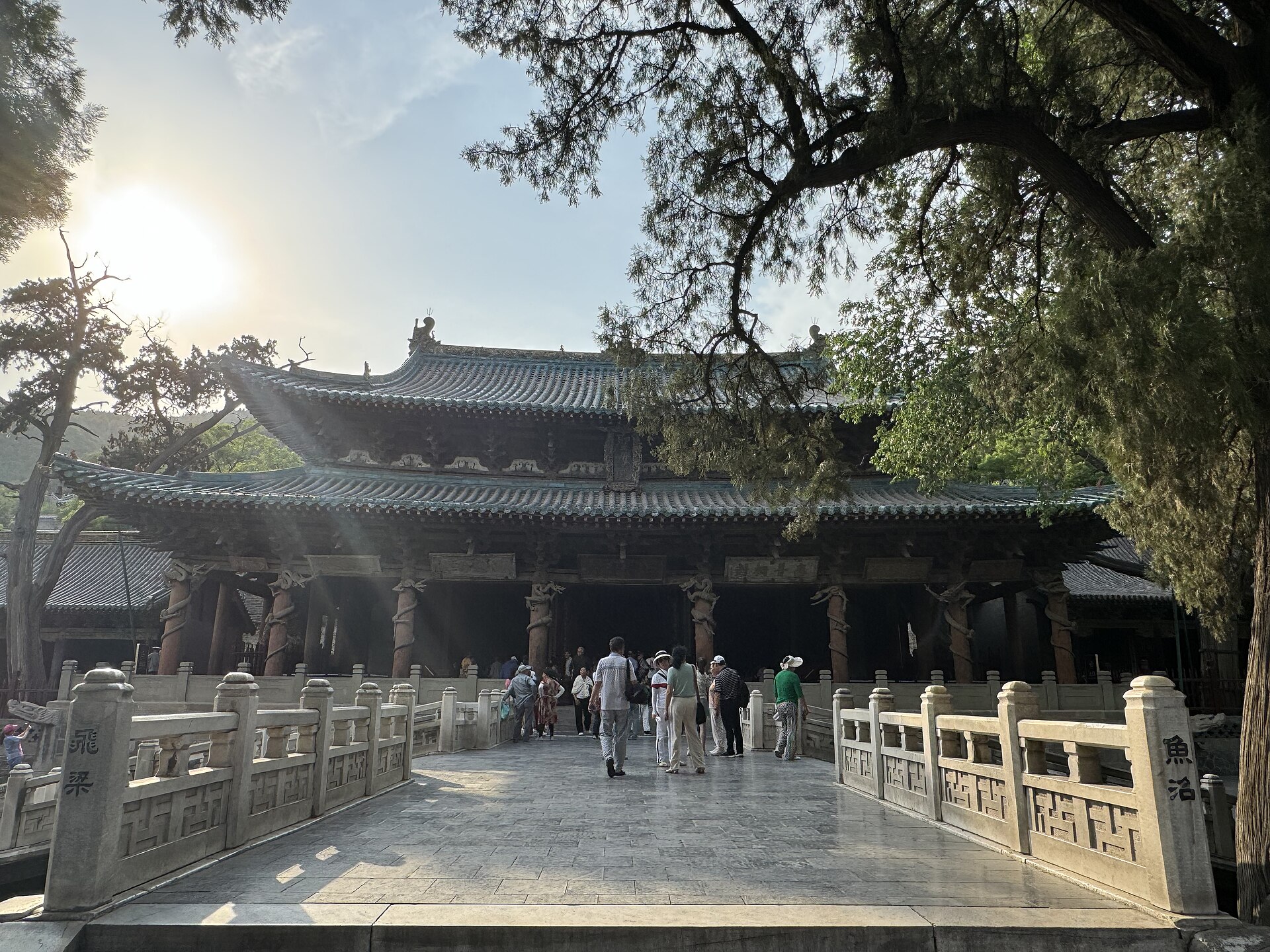
Jinci Temple: a local guide
Southwest of Taiyuan, at the foot of Xuanweng Mountain where the Jin River rises, Jinci Temple is a temple, a garden and a spring, built up over more than a thousand years. It is not one building but a whole landscape of halls, pavilions, pools and ancient trees — and the locals' own answer to the question of what to see first in Shanxi.
The three treasures
- The Zhou cypress (周柏) — a cypress said to be around three thousand years old, its trunk split and leaning, held up by an iron prop. It is the oldest living thing in the temple, and the first thing most visitors stop to look at.
- The Song-dynasty painted sculptures (宋代彩塑) — forty-three life-size figures in the Sage Mother Hall, each one different: the seated Lady Jiang at the centre, and around her officials, maids and attendants, every face and robe its own. For many art historians they are the finest Song sculpture still standing in China.
- The Nanlao Spring (难老泉) — the clear spring that has fed the temple for more than a thousand years. The water runs warm in winter and cool in summer, and the whole temple is laid out around it: halls, pools and gardens following the water, not the other way round.
The Sage Mother Hall
The main hall of Jinci is the Sage Mother Hall (圣母殿), built in the Song dynasty to honour the mother of Tang Shuyu, the founder of the ancient state of Jin. It is a hall of unusual grace: a double-eaved roof, a colonnade running all the way round, and inside it the forty-three painted figures, quiet and lifelike in the half-light. Stand in front of them for a while — no two faces are the same, and the hall rewards patience more than any other room in the temple.
Water and gardens
- The Fish Marsh Flying Beam (鱼沼飞梁) — a Song-dynasty cross-shaped stone bridge over a square pool, the only one of its kind still standing in China. Walk across it slowly: the bridge, the water and the halls around it are the heart of Jinci.
- The springs — the Nanlao Spring and the smaller Shanli Spring feed pools and channels through the whole temple. Come early in the morning, when mist still hangs over the water and the reflections break in the pools.
- The stele corridor and the iron figures — the east corridor holds stone tablets from many dynasties, including the inscription written by the Tang emperor Taizong himself. The Northern Song iron figures stand nearby, heavy and weathered, watching over the pools.
- The hillside — climb to the reading terrace halfway up Xuanweng Mountain for the view back over the whole temple: grey tile roofs, old trees and the springs below.
How long
Half a day. The main axis — from the Water Mirror Terrace through the halls to the Sage Mother Hall — takes about an hour at a walking pace, but the side halls, the springs and the gardens are worth another hour or two. Jinci fits naturally as a half-day trip from Taiyuan, or on the way south to Pingyao and the merchant courtyards.
Frequently asked questions
How long do I need at Jinci Temple?
Half a day. The main axis — from the Water Mirror Terrace through the halls to the Sage Mother Hall — takes about an hour at a walking pace, but the side halls, the springs and the gardens are worth another hour or two. Do not rush it; Jinci is a place to walk slowly.
What are the three treasures of Jinci?
The Zhou cypress, a tree said to be around three thousand years old; the Song-dynasty painted sculptures in the Sage Mother Hall, forty-three figures, each one different; and the Nanlao Spring, the clear spring that has fed the temple gardens for more than a thousand years.
How do I get to Jinci Temple from Taiyuan?
Jinci lies southwest of Taiyuan, at the foot of Xuanweng Mountain where the Jin River rises. It is a drive from the city centre, and our tours collect guests from their hotel. It is the finest half-day trip from Taiyuan, and it fits naturally on the way south to Pingyao.
Is Jinci crowded?
The main axis can be busy in the middle of the day, especially at weekends. Go early in the morning, when mist still hangs over the springs and the courtyards are quiet — and walk the side halls, where most visitors never go.
Plan your private trip
Tell us your dates and party size — we reply within 24 hours with a draft route and a clear quotation. Every tour is private, with an English-speaking guide and a private driver.
Jinci Temple is a stop on our 7-Day Shanxi Panorama (from US$1,599 per person), and we can add it to any custom route through Taiyuan. To plan a private Jinci visit, email us at 18635571515@163.com or message us through the Jinji Yousheng (晋迹有声) WeChat mini program.